
Why habits fail
How to Keep Your Habits When Life Gets Busy
Short answer
When life gets busy, protect the habit by reducing its size, keeping one recognizable cue, and defining a fast restart. A routine that only works on an ideal day is not yet resilient. The goal is to preserve the next repetition, not to perform the maximum version every time.

Why a changed day can break a familiar routine
Habits are connected to context. Time, place, preceding actions, and other environmental cues can all become part of the trigger. Travel, deadlines, illness, a move, or a new work schedule can remove those cues even when your goal has not changed.
Research on habit discontinuity describes how context changes can weaken the influence of an established habit. That disruption can make a good routine harder to continue, but it can also create an opportunity to choose a new cue deliberately. See the open-access study on habit discontinuity and context change.
Give the habit three sizes
Define three versions before the difficult day arrives:
- Full version: the action you prefer when time and energy are available.
- Reduced version: a smaller action that keeps the same direction.
- Minimum version: the briefest honest repetition that preserves contact with the habit.
For example, a full writing session might be forty-five minutes, a reduced version fifteen minutes, and a minimum version one edited paragraph. The minimum is not a permanent target. It is a bridge across an unusual day.
Keep a cue, even when the schedule changes
Clock times are fragile when a day becomes unpredictable. Event-based cues can travel better. "After I open my laptop" may survive better than "at 7:00 p.m." If the original cue disappears, choose a replacement that is already present in the new context.
Then prepare an if-then fallback:
If the normal session cannot happen, I will complete the reduced version before I finish the day.
Keep the fallback specific. Vague promises create another decision at the exact moment your attention is already overloaded.
Restart without paying a penalty
A missed repetition is information about the system, not a verdict on the person. Ask what changed: the cue, the available time, the difficulty, or the environment. Adjust one of those variables and schedule the next action.
Avoid waiting for a symbolic restart date. The next available cue is more useful than next Monday.
How Habit Dungeon applies the idea
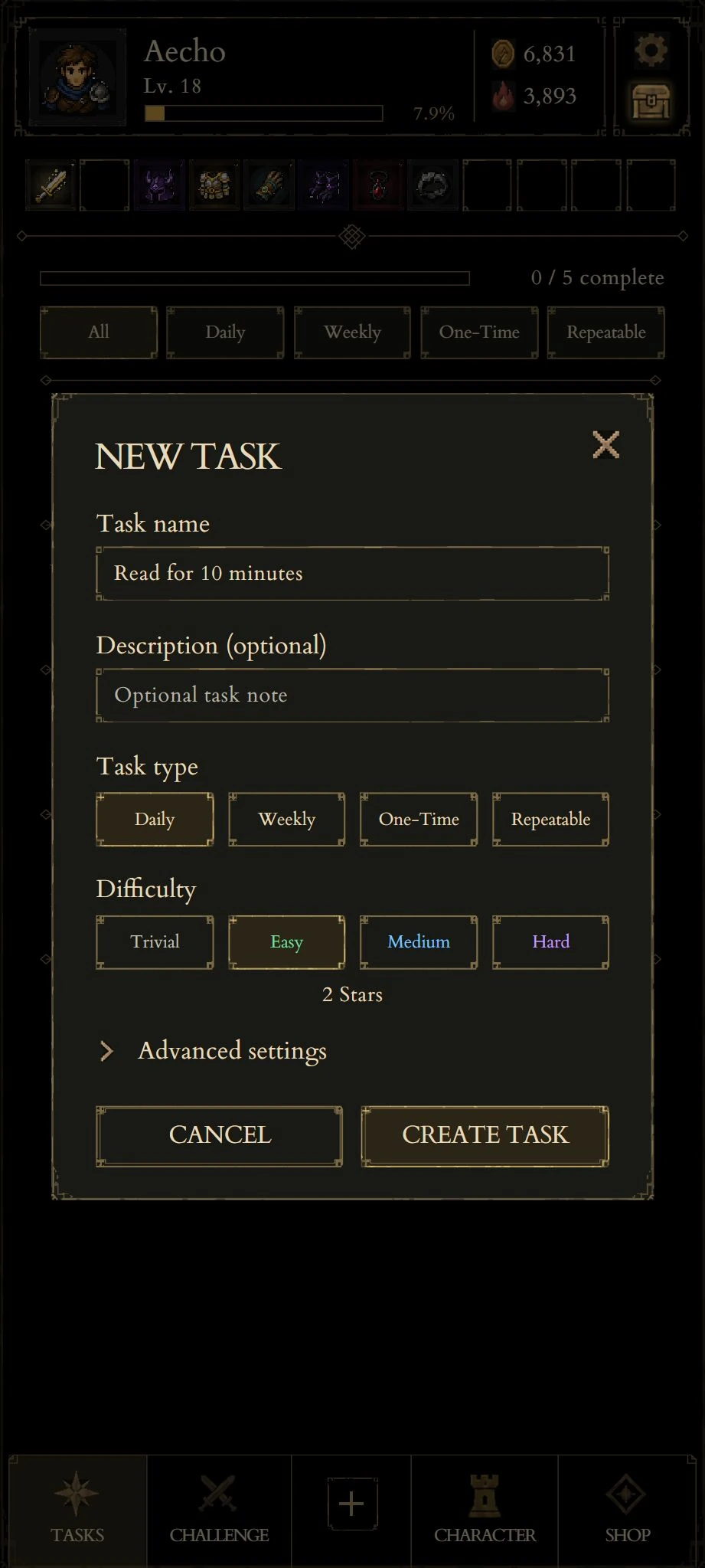
Habit Dungeon supports small, concrete habit descriptions and gives the completion an immediate result. When a routine changes, you can reduce the real action and continue building visible progress rather than treating one disrupted day as a lost run.
The How Habit Dungeon Works page shows where that smaller completion fits into the full reward loop.
The game layer should support a flexible routine. It should not pressure you to complete an unsafe or unrealistic action simply to protect a number.
Continue with How to Turn Daily Habits Into Game-Like Challenges or revisit why habit motivation fades.
Source
- Bas Verplanken and Deborah Roy, Habit Discontinuity, Self-Activation, and the Diminishing Influence of Context Change.
First-party product example
What this looks like in Habit Dungeon
Habit Dungeon starts with a concrete habit description. A smaller fallback can remain the same kind of action without turning an interrupted day into a total reset.
Keep reading
Related guides

Why Does Habit Motivation Fade So Quickly?
Motivation naturally changes. A useful habit system reduces how much each repetition depends on feeling inspired.
Read guide
How to Turn Daily Habits Into Game-Like Challenges
A good challenge is specific enough to start, demanding enough to matter, and flexible enough to adjust.
Read guide