
How gamification helps
How to Turn Daily Habits Into Game-Like Challenges
Short answer
Turn a habit into a challenge by defining one observable action, choosing a difficulty you can adjust, showing progress, and writing a recovery rule. The challenge should create focus and feedback without making a normal interruption feel like total failure.

A challenge needs a clear win condition
"Get healthier" is a direction. "Walk for twenty minutes after lunch on four days this week" is a challenge. The second version tells you what to do, when to start, and how completion will be recognized.
Use this structure:
I will complete [action] after [cue] on [frequency]. The minimum valid version is [fallback].
The action should remain under your control. A result such as losing a fixed amount of weight depends on more than one daily decision and is better treated as an outcome measure.
Choose difficulty without choosing punishment
Goal-setting research has repeatedly examined the value of specific, challenging goals. Locke and Latham's review emphasizes that difficulty works together with commitment, ability, knowledge, and feedback. A difficult goal is not automatically a good goal. Read Building a Practically Useful Theory of Goal Setting and Task Motivation.
Use three difficulty checks:
- Can you begin the action without another planning session?
- Can you complete it safely with your current time and ability?
- Will completion require attention without requiring an ideal day?
If the answer to the second question is no, reduce the challenge. If the answer to the third is no, the challenge may be too easy to remain meaningful.
Add progress and a recovery rule
A challenge becomes more usable when it shows how far you have moved and what remains. Track completions or stages, then decide in advance what happens after an interruption.
A practical recovery rule is simple:
If I miss the planned action, I will complete the fallback at the next available cue and continue the same challenge.
This keeps the challenge from turning one missed event into a forced restart.
Make the game layer serve the behavior
Game-like challenges can add bosses, levels, cooperative goals, or rewards. Each element should connect to a real completion. Avoid hidden rules, changing targets, or punishment that encourages unsafe behavior.
The challenge is successful when it helps you choose and complete the next action, even if the visual reward is modest.
How Habit Dungeon applies the idea
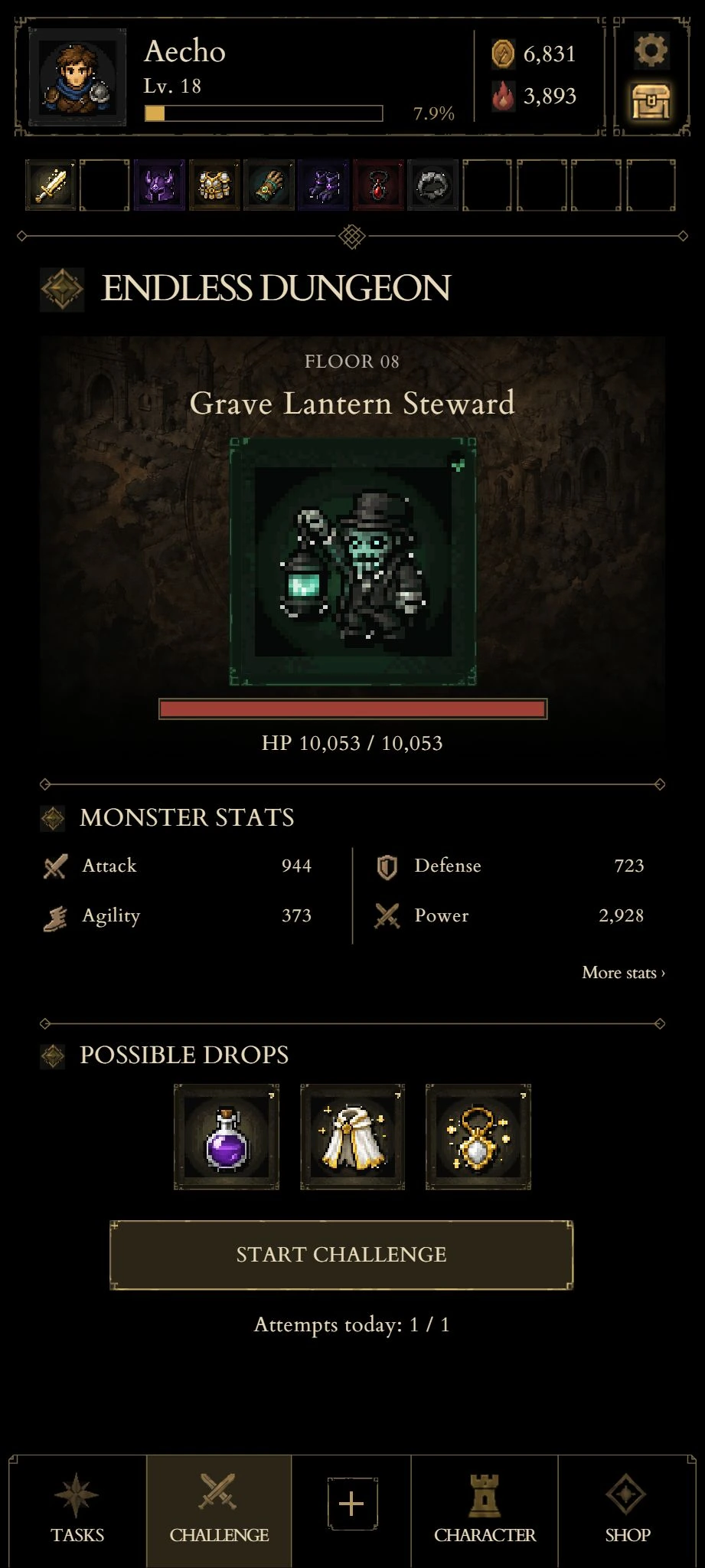
Habit Dungeon lets completed habits build character power that can be used in the Endless Dungeon, cooperative Greater Rifts, and leaderboards. The boss or dungeon provides a game objective, while the required progress still begins with real-life actions.
See How Habit Dungeon Works for the complete path from a real action to a game challenge.
The app does not guarantee a specific behavior outcome. Adjust the action to your own situation and follow professional advice when a goal involves health or safety.
Continue with How to Keep Your Habits When Life Gets Busy or Gamified Habit Progress.
Source
- Edwin A. Locke and Gary P. Latham, Building a Practically Useful Theory of Goal Setting and Task Motivation.
First-party product example
What this looks like in Habit Dungeon
Completed habits build a character that can enter the Endless Dungeon and other challenges. The dungeon supplies the game objective; the progress still begins with real-world actions.
Keep reading
Related guides

How to Keep Your Habits When Life Gets Busy
A disrupted routine is not a character flaw. Build a fallback version that can survive a different day.
Read guide
Gamified Habit Progress: Using Levels and Rewards
Game progression is most useful when it makes completed work visible and keeps the real action at the center.
Read guide